
What Makes Something a Financial Product?
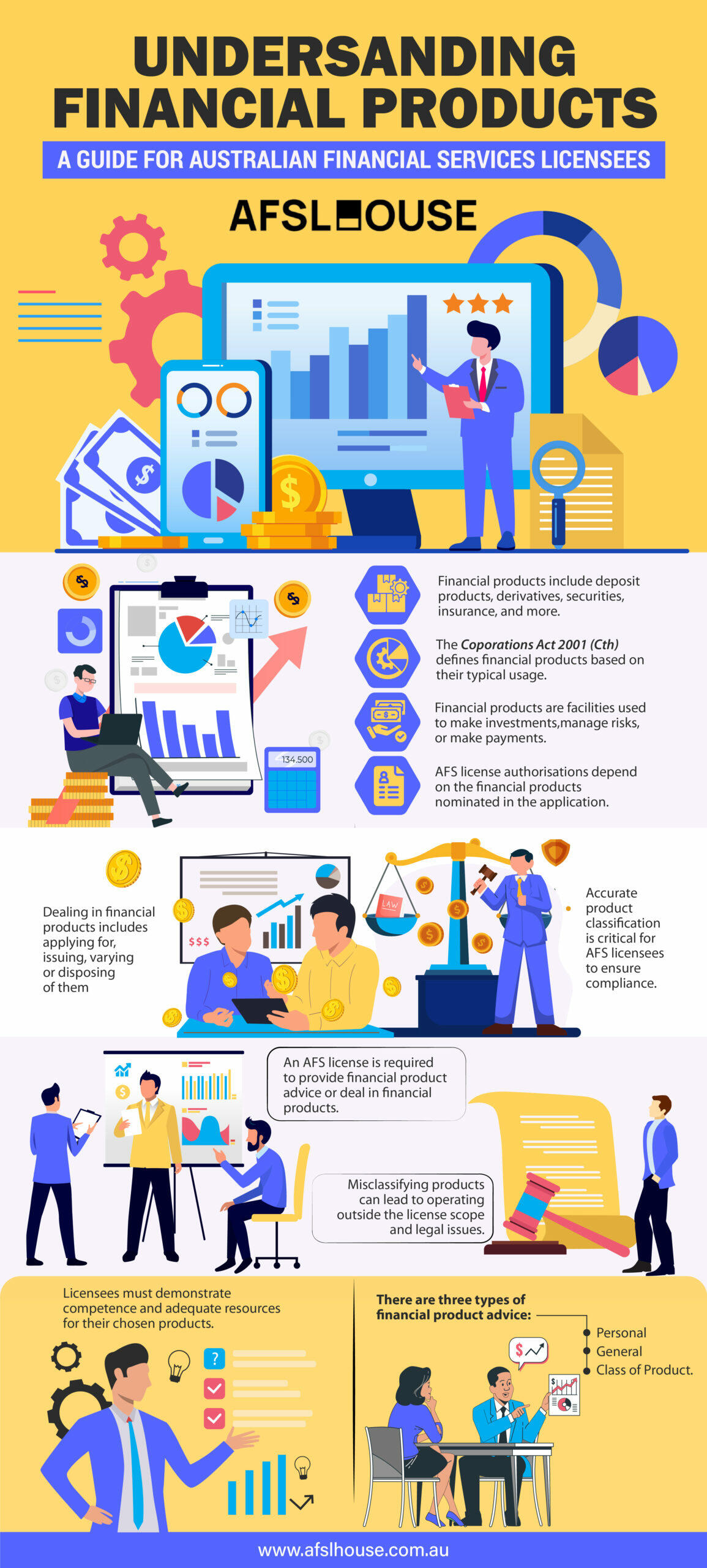
A financial product is a facility through which, or through the acquisition of which, a person makes a financial investment, manages financial risk or makes non-cash payments. That’s the general definition in s 763A(1) of the Corporations Act 2001 (Cth) (‘Corporations Act’). The Act also lists products that are always included (s 764A) and things that never are (s 765A), and the exclusions win.
The test looks at what a facility does, not what it’s called. A facility of a kind people commonly use for one of those three purposes is a financial product even if a particular person acquires it for another reason (s 763A(2)). The hard call is a new product, platform or payment feature that doesn’t fit a listed category, because the answer decides whether you need an Australian Financial Services Licence (‘AFSL’) and which authorisations it must include.
What Counts as Investing, Managing Risk or Making Non-Cash Payments?
Each has a statutory meaning. Investing means another person uses (or is meant to use) your money to generate a return for you, managing risk means limiting the financial consequences of events or price movements, and non-cash payments are payments not made in notes and coins. The Act gives examples of conduct on each side of the line.
- Making a financial investment (s 763B): You give money or money’s worth to another person who uses it, or intends it to be used, to generate a financial return or other benefit for you, and you have no day-to-day control over that use. Paying a company for an issue of shares is an example; buying real property or bullion isn’t.
- Managing financial risk (s 763C): You manage the financial consequences to you of particular circumstances happening, or avoid or limit the financial consequences of fluctuations in receipts or costs, including prices and interest rates. Insurance and hedging with a futures contract or currency swap are examples; hiring a security firm isn’t.
- Making non-cash payments (s 763D): You make payments, or cause them to be made, other than by physically delivering notes and coins. Direct debit, cheques, smart cards and traveller’s cheques are examples.
A financial feature that is only incidental can fall outside the general definition. If it’s an incidental component of a facility, and the facility’s main purpose isn’t investing, managing financial risk or making non-cash payments, it isn’t a financial product under the general definition, though it can still be one under the specific list (s 763E).
From the Act · s 763B, note 2
The Corporations Act gives this as an action that isn’t making a financial investment: a person giving money to a financial services licensee who is to use it to purchase shares for the person. The purchase of the shares will be a financial investment made by the person, but the mere act of giving the money to the licensee won’t of itself be one.
What it means: look at the facility the client ends up holding, not every step in the transaction.
Get Your Free Initial Consultation
Consult with one of our experienced ACL & AFSL Lawyers today.
Which Products Are Always Financial Products?
The products listed in s 764A(1) are financial products even if they wouldn’t meet the general test, subject to the exclusions in s 765A. They are:
- securities, such as shares;
- interests in registered managed investment schemes, in unregistered schemes that meet at least one of the tests in s 601ED(1)(a) to (c), and in notified foreign passport funds;
- derivatives;
- general insurance, life policies and sinking fund policies, with exceptions such as funeral benefits and cover an employer issues to its employees;
- superannuation products and retirement savings accounts;
- deposit-taking facilities an authorised deposit-taking institution offers in the course of its banking business;
- debentures, stocks or bonds issued by a government;
- foreign exchange contracts that aren’t derivatives or settled immediately;
- Australian carbon credit units and eligible international emissions units;
- margin lending facilities; and
- anything declared by the regulations to be a financial product.
Being excluded from one paragraph doesn’t settle the question. Something carved out of one paragraph can still be a financial product under another paragraph or under the general definition (note to s 764A(1)). So test the product against every paragraph, including those for managed investment schemes and carbon credits.
What Isn’t a Financial Product?
Some things are excluded even if they meet the general test or appear on the list, including credit facilities, health insurance and reinsurance (s 765A(1)). The main exclusions are:
- credit facilities within the meaning of the regulations, other than margin lending facilities, and payment facilities where every payment is debited to such a credit facility (s 765A(1)(h));
- certain insurance, including health insurance provided as part of a health insurance business, insurance provided by the Commonwealth, State or Northern Territory insurance, and reinsurance (s 765A(1)(c), (d), (e) and (g));
- currency exchanges settled immediately (s 765A(1)(m));
- market infrastructure, such as a financial market, a clearing and settlement facility or a derivative trade repository (s 765A(1)(l)); and
- anything the regulations or ASIC declare not to be a financial product (s 765A(1)(y) and (z)).
An exclusion doesn’t put a product outside every law. Under s 29 of the National Consumer Credit Protection Act 2009 (Cth), a person must not engage in a credit activity without a licence that authorises it, so a credit business generally needs an Australian Credit Licence instead. The consumer protection rules in the Australian Securities and Investments Commission Act 2001 (Cth) (‘ASIC Act’) also treat a credit facility as a financial product (s 12BAA(7)(k)).
Speak with an ACL & AFSL Lawyer Today
Request a Consultation to Get Started.
How Do Your Products Shape Your AFS Licence?
Your licence must cover each financial service you provide, and the Australian Securities and Investments Commission (‘ASIC’) authorises services product category by product category. The licence requirement is in s 911A(1), and the categories ASIC uses are in Table 3 of its licensing guide (RG 1.111 and Table 3):
- deposit products (basic and non-basic) and non-cash payment facilities;
- derivatives and foreign exchange contracts;
- general insurance and life products;
- interests in managed investment schemes, superannuation and retirement savings account products;
- securities and government debentures, stocks or bonds;
- margin lending facilities and carbon credits; and
- miscellaneous financial investment products and miscellaneous financial risk products.
For each category, ASIC’s table lists the financial services that may relate to it, such as dealing by issuing the product or giving general or personal advice about it. The services themselves are in s 766A(1): financial product advice, dealing, making a market, operating a registered scheme or a CCIV, custodial or depository services, crowd-funding, claims handling and settling, superannuation trustee services, and traditional trustee company services (s 766A(1A)).
Your products then shape the rest of the licence:
- Responsible managers: Together, they need appropriate knowledge and skills for every service and product on the licence (RG 105.8).
- Restricted titles: You can only call yourself a stockbroker, futures broker or insurance broker if the conditions on your licence, or your licensee’s licence if you’re its representative, authorise it (s 923B). An unauthorised use is an offence for each day it continues (s 923B(2)).
- New products: If you plan to expand the products or services you provide, you’re likely to need to apply to vary your licence (RG 1.38).
In a new AFS licence application, you describe your products and services in the ASIC Regulatory Portal and support your responsible managers with People Proofs. If ASIC is looking to approve the application, it then asks for financial statements at the requirements stage (INFO 294). That stage is what replaced the B5 proof.
What Happens if Your Licence Doesn’t Cover a Product?
You may be carrying on a financial services business without a licence covering those services. That’s an offence (s 911A(1) and s 1311(1)) and a civil penalty provision (s 911A(5B)), and the licence you hold doesn’t help for a service it doesn’t cover, because s 911A(1) requires a licence “covering the provision of the financial services”.
Court case · ASIC 26-008MR
In 2024 the Federal Court found BPS Financial Pty Ltd had engaged in unlicensed conduct for almost three years by issuing, and giving financial advice about, its ‘Qoin Wallet’, a non-cash payment facility linked to a crypto token, without an AFSL. In January 2026 the Court ordered penalties of $14 million, $2 million for the unlicensed conduct and $12 million for misleading conduct, and restrained BPS for 10 years from carrying on a financial services business without an AFSL.
What it means: a payment feature can be a financial product in its own right, so check new features against your authorisations before launch.
ASIC can also act against the licence itself. It can impose conditions (s 914A(1)), or suspend or cancel the licence after offering a hearing if you haven’t complied with your general obligations (s 915C(1)(a)), which include complying with the financial services laws. Those licence actions sit alongside the consequences of operating without an AFSL.
The fix is timing. Check each new product before launch, and if it’s outside your authorisations, apply to vary your AFSL before you start.
Get Your Free Initial Consultation
Consult with one of our experienced ACL & AFSL Lawyers today.
How Should You Check Whether a New Product Is a Financial Product?
Work through the Act in the order it applies:
- Check the exclusions. If s 765A(1) excludes it, or ASIC or the regulations declare it isn’t a financial product, the Corporations Act definition doesn’t catch it, though other laws may.
- Check the specific list. If it’s in s 764A(1), it’s a financial product.
- Apply the general test. Ask whether people commonly use a facility of that kind to invest, manage financial risk or make non-cash payments (s 763A), and whether the financial part is only incidental (s 763E).
- Name the services. Identify whether you’ll advise on it, deal in it, make a market in it or hold it for clients (s 766A(1)).
- Match your licence. Compare the product category and services with your authorisations (RG 1 Table 3), and vary the licence before you start.
AFSL House’s lawyers can review your product and business model, map them to the right authorisations, and prepare your licence application or variation.
Frequently Asked Questions
These are the questions licensees and founders ask most about what counts as a financial product.
Is insurance a financial product?
Usually, yes. General insurance, life policies and sinking fund policies are financial products under s 764A(1)(d) to (f), so advising on or dealing in them generally needs an AFSL. The exceptions include health insurance provided as part of a health insurance business, insurance provided by the Commonwealth, State or Northern Territory insurance, reinsurance, and insurance an employer issues to its employees (s 765A(1)).
Is a loan or credit card a financial product?
Not under the Corporations Act. A credit facility within the meaning of the regulations, other than a margin lending facility, is excluded (s 765A(1)(h)), and credit activities need an Australian credit licence instead (s 29 of the National Consumer Credit Protection Act). For the ASIC Act’s consumer protection rules, though, a credit facility is a financial product (s 12BAA(7)(k)).
Are crypto assets financial products?
Some are. The High Court held that Block Earner’s fixed-yield “Earner” product was a financial product (ASIC v Web3 Ventures Pty Ltd [2026] HCA 21). From 8 April 2027, the Corporations Amendment (Digital Assets Framework) Act 2026 (Cth) makes digital asset platforms and tokenised custody platforms financial products, unless the platform is a managed investment scheme (new s 764A(1)(la) and (lb)). Crypto businesses should check both.
Is buying property or gold a financial investment?
Not by itself. The Act’s own note says buying real property or bullion isn’t making a financial investment, because any return isn’t generated by another person using the purchase money (note 2 to s 763B). The answer can change if your money is pooled with other people’s and someone else uses it to generate a return for you, because that can be an interest in a managed investment scheme.
Is a gift card a non-cash payment facility?
Not if only one person can be paid with it. Making payments through a facility where there is only one person to whom payments can be made isn’t making non-cash payments (s 763D(2)(a)(i)). Multi-merchant cards can differ, and the regulations can exclude other facilities with limits on payees or users (s 763D(2)(a)(ii)), so check the non-cash payment facility rules.
Does a product stop being a financial product when it’s resold?
No. A facility doesn’t cease to be a financial product merely because someone other than the person it was originally issued to acquires it, even if that person isn’t making a financial investment or managing a financial risk (s 763A(3)). If you deal in products other people first acquired, assess them the same way the issuer would.
Can ASIC decide that something isn’t a financial product?
Yes. ASIC may declare in writing that a specified facility, interest or other thing isn’t a financial product, and it must publish notice of the declaration in the Gazette (s 765A(2)). The regulations can also exclude things, generally or for specified provisions (s 765A(1)(y) and (3)), and declare extra things to be financial products (s 764A(1)(m) and (3)). Check for a declaration before relying on the general test.
Can you call yourself a stockbroker or insurance broker?
Only if the conditions on your licence, or on your licensee’s licence if you’re its representative, authorise it (s 923B(1)). ASIC can only authorise “stockbroker” or “sharebroker” if you can provide a financial service relating to securities and are a participant in a licensed market covering securities, and “insurance broker” if your service relates to insurance and you act on behalf of intending insureds (s 923B(3)).
Do you need an AFSL for every financial product you deal with?
Not always. Exemptions include providing the service as the representative of a licensee whose licence covers it (s 911A(2)(a)), and work of a kind ordinarily done by clerks or cashiers isn’t a financial service at all (s 766A(3)). ASIC can also grant relief (s 926A). Exemptions apply service by service, so check each one against the AFSL exemptions for domestic companies.
Disclaimer: All information provided in this article is strictly general in nature and is not intended to be, nor should it be relied upon as, legal advice.