
What Licences Can a Crypto Business Need in Australia?
There is no single crypto licence in Australia. Depending on what your business does, you may need to register with AUSTRAC, hold an Australian financial services licence (‘AFSL’) and, if you run a trading platform, hold an Australian market licence or rely on an exemption. ASIC’s Information Sheet 225 Digital assets: Financial products and services (‘INFO 225’), updated in October 2025, explains how the existing law applies to digital assets.
- AUSTRAC registration: You must be registered with AUSTRAC before providing virtual asset services in Australia, such as exchanging virtual assets for money or other virtual assets, safekeeping them, or transferring them for customers (AUSTRAC).
- AFSL: You need an AFSL, or an exemption, to provide financial services in relation to digital assets that are financial products (s 911A of the Corporations Act 2001 (Cth) (‘Corporations Act’); INFO 225).
- Australian market licence: A platform where offers to buy or sell digital assets that are financial products are made or accepted may be operating a financial market, which needs a market licence unless an exemption applies (INFO 225).
The first decision is whether your tokens and services involve a financial product. The second is whether your platform falls within the new digital asset platform rules that start on 8 April 2027.
When Is a Digital Asset a Financial Product?
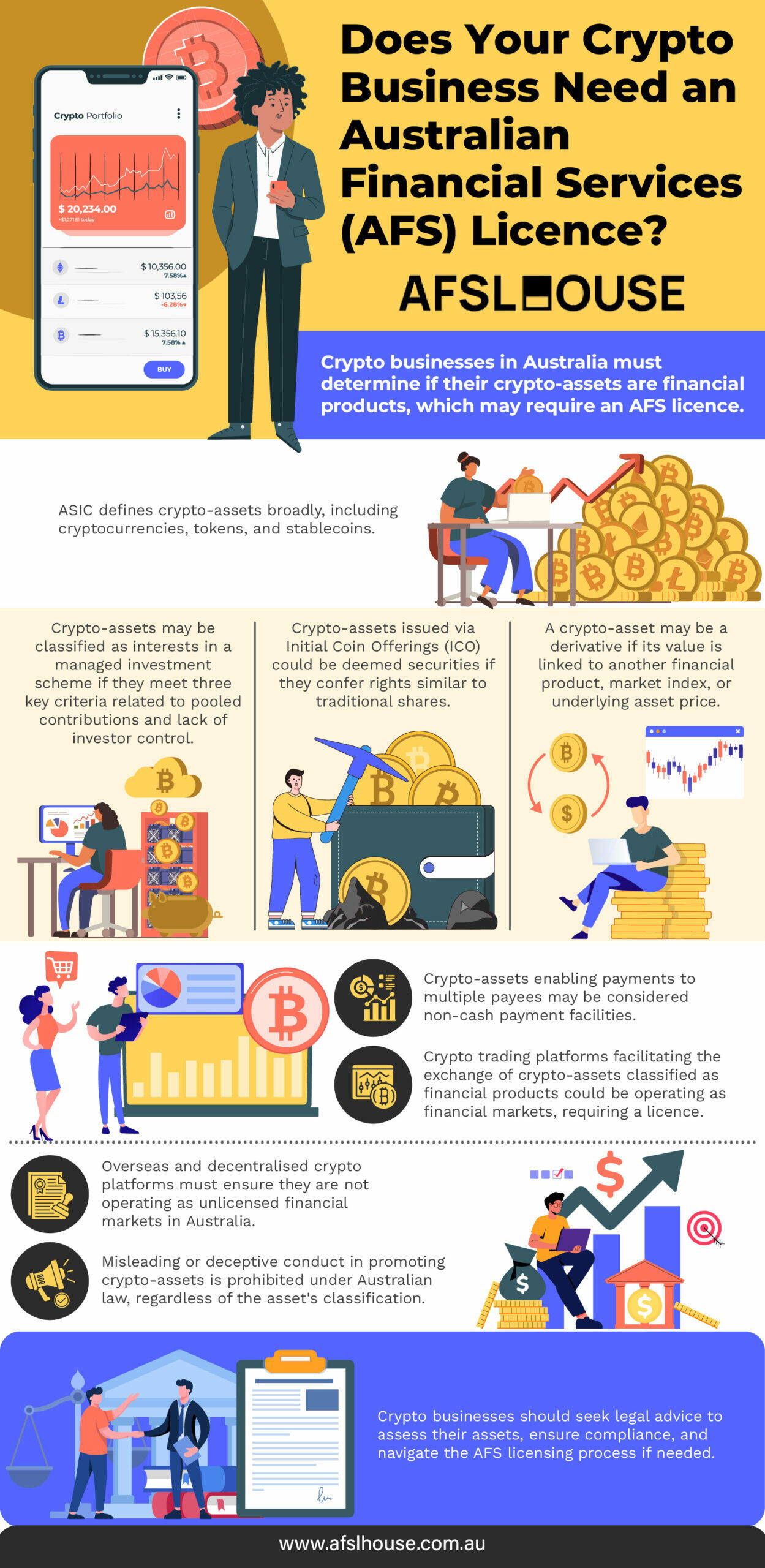
A digital asset is a financial product if its rights and features meet one of the financial product definitions in the Corporations Act, whatever the business calls it (INFO 225). ASIC asks whether the asset is, or involves, a managed investment scheme, a security, a derivative, a non-cash payment facility or a facility for making a financial investment.
One asset can meet more than one definition, and a product that isn’t a financial product on its own can become part of one when it is bundled with other products or services (s 761B; INFO 225).
ASIC says the High Court confirmed that the definitions are broad and technology neutral (ASIC news item). The case held that Block Earner’s fixed-yield “Earner” product was a financial product (ASIC v Web3 Ventures Pty Ltd [2026] HCA 21). INFO 225 works through 18 examples. ASIC’s views on five common ones:
| Digital asset | ASIC’s view in INFO 225 |
|---|---|
| Bitcoin (Example 5) | Unlikely to be a financial product, though it can be used within a separate payment facility that is |
| Yield-bearing stablecoin (Example 6) | Likely to be an interest in a managed investment scheme |
| Wrapped token (Example 16) | Likely to be a derivative |
| Wallet with a “pay anyone” feature (Example 17) | May be a non-cash payment facility |
| Non-interest-bearing stablecoin (Example 18) | Likely to be a non-cash payment facility |
Document your analysis for each asset and service, and revisit it when the design changes, because ASIC expects entities to seek advice and keep complying as a digital asset’s features change over its life cycle (INFO 225). Base that analysis on the general financial product definitions in the Corporations Act. ASIC’s first example shows how much a white paper can decide.
ASIC example · INFO 225 Example 1
Company A runs a digital asset exchange and issues a token whose white paper says it raises funds to develop the exchange, offering a financial return or other benefit subject to the exchange’s success. Company A intends, without being obliged, to buy the tokens back if the exchange meets certain success metrics. ASIC says the token is likely to be a facility for making a financial investment, and would still likely be a financial product without the buy-back, because of the representations about a return.
What it means: what your white paper and marketing promise can make a token a financial product, so review them alongside the token’s terms.
Get Your Free Initial Consultation
Consult with one of our experienced ACL & AFSL Lawyers today.
When Is a Crypto Project a Managed Investment Scheme?
A crypto project is likely to be a managed investment scheme if three things are true (INFO 225, Figure 1). People contribute money or money’s worth for rights to benefits, the contributions are pooled or used in a common enterprise to produce financial or property benefits, and the contributors don’t have day-to-day control of the operation. ASIC notes that a right to be consulted, such as voting on proposals, or to give directions, such as entering, withdrawing or changing investment allocations, isn’t enough to amount to day-to-day control.
ASIC says that if a scheme is offered to retail investors, the issuer will likely need an AFSL authorising it to act as responsible entity, and must comply with its licence obligations and the additional obligations of responsible entities (INFO 225). The scheme will also need to be registered with ASIC if it meets the conditions in s 601ED, such as having more than 20 members.
ASIC says a wholesale scheme may still need an AFSL with the correct authorisations, and that the operator must have a process that lets only wholesale clients invest (INFO 225). Those are the same questions any managed investment scheme operator faces.
When Is a Token a Security, Derivative or Payment Facility?
A token can be a security, a derivative or a non-cash payment facility, depending on its features (INFO 225). It can be a security if it carries share-like or debenture-like rights, a derivative if its value comes from another asset, and a non-cash payment facility if people can use it to make payments to more than one person. Each classification brings different obligations:
- Security: An issuer offering a security to retail investors will generally need to prepare a prospectus containing all the information investors reasonably require to make an informed decision (INFO 225).
- Derivative: ASIC says an issuer offering a derivative needs an AFSL with authorisations to issue it, unless an exemption applies, and anyone arranging or advising on it needs the relevant authorisations too (INFO 225).
- Non-cash payment facility: Wallets, custodial or non-custodial, may be payment facilities where users can pay third parties, and some tokens designed as a means of payment can themselves be one (INFO 225).
The Federal Court found that BPS Financial issued its Qoin Wallet, a non-cash payment facility linked to the Qoin token, and gave advice about it without an AFSL (ASIC v BPS Financial Pty Ltd [2024] FCA 457). The Court later ordered $14 million in penalties, $2 million of it for the unlicensed conduct (26-008MR). So treat any wallet or payment feature as a possible non-cash payment facility until you’ve checked it.
ASIC example · INFO 225 Example 17
Company P offers a custodial wallet, controlling the private keys and acting on customers’ instructions, and markets the convenience of ‘making payments to anyone’. Its second wallet is software that lets customers create their own keys, which Company P can’t access, and still lets them pay other wallets. ASIC says both may be non-cash payment facilities, the first more likely because of how it’s marketed. Company P’s control over the second wallet isn’t relevant, though the incidental product exclusion in s 763E may apply.
What it means: a wallet doesn’t need to be custodial or marketed for payments to be a financial product, so test what users can actually do with it.
Speak with an ACL & AFSL Lawyer Today
Request a Consultation to Get Started.
Do Crypto Exchanges Need a Market Licence, an AFSL or AUSTRAC Registration?
A crypto exchange may need all three: AUSTRAC registration, a market licence (or an exemption) and an AFSL. That’s AUSTRAC registration for its exchange and custody services, a market licence if one or more financial products trade on it, and an AFSL for the financial services it provides. ASIC says a single financial product trading on your platform is enough for you to be operating a financial market (INFO 225).
If you act as a market maker or broker, making or accepting offers on your own behalf or for one party to a transaction, you may not be operating a market. You would typically need an AFSL rather than a market licence (s 767A(2)(a); INFO 225). So be clear on the difference between making a market and operating a market, and remember that AUSTRAC registration and the AFSL are separate requirements.
AUSTRAC registration has its own obligations. You must renew it every 3 years and keep your details up to date, and AUSTRAC can refuse, suspend, cancel or impose conditions on a registration (AUSTRAC).
What Changes for Crypto Platforms From 8 April 2027?
From 8 April 2027, digital asset platforms and tokenised custody platforms become financial products, unless the platform is a managed investment scheme. That change comes from the Corporations Amendment (Digital Assets Framework) Act 2026 (Cth) (‘DAF Act’) (new s 764A(1)(la) and (lb)). ASIC’s 26-245MR also gives 8 April 2027, while its final-call news item says 9 April 2027, and ASIC’s proposed guidance says firms will need to apply for, or vary, an AFSL.
- Digital asset platform: A facility under which an operator possesses digital tokens for or on behalf of another person, such as by acting as trustee or bailee (DAF Act, new definition).
- Tokenised custody platform: A facility under which an operator holds assets other than money for clients and creates a digital token for each asset that gives a right to redeem it or direct its delivery (DAF Act, new definition).
- Small platforms: Issuing a digital asset platform is exempt where, among other conditions, no financial products are held under it, transactions in the last 12 months don’t exceed $10 million, each client’s entry values don’t exceed $5,000, and the operator has notified ASIC (new s 911A(2)(ja)).
- Transition: For 6 months after commencement, the new rules don’t apply to an operator whose AFSL doesn’t yet authorise the service, and if it applies in that period they don’t apply until the day after ASIC decides (new s 1732).
ASIC consulted on standards and guidance for the new regime in Consultation Paper 392 until 27 November 2026 (26-245MR). It proposes to simplify licensing for existing licensees and INFO 225 applicants adding these authorisations, and ASIC says many existing authorisations will still be required after the new framework commences (final-call news item).
Get Your Free Initial Consultation
Consult with one of our experienced ACL & AFSL Lawyers today.
What If You Were Already Operating Without a Licence?
ASIC’s sector-wide no-action position closed to new applicants on 30 September 2026. It only covers firms that met its conditions by that date, such as lodging an AFSL application or variation (ASIC class no-action letter). For a firm that lodged in time, ASIC doesn’t intend to take action over its unlicensed services until ASIC grants or refuses the application, or the firm withdraws it. Other conditions include:
- the firm first provided the services in Australia on or before 31 December 2025; and
- a firm serving retail clients joined AFCA before lodging its application.
Firms needing a market licence had to notify ASIC of their intention to apply and attend a pre-application meeting by 30 September 2026, then lodge within 12 months of notifying. From 1 October 2026, firms that need a licence or variation but haven’t met the conditions risk civil and criminal penalties, including fines of up to 10% of annual turnover (final-call news item).
Do Overseas Crypto Businesses Need an Australian Licence?
Australian laws apply where a digital asset is promoted or sold, or services are provided in relation to it, in Australia, including from offshore. ASIC says offshore or decentralised structures don’t remove key obligations (INFO 225), so it expects an overseas platform without an Australian market licence to make sure it doesn’t operate as a financial market in Australia, unless an exemption applies.
ASIC lists steps that may be needed to keep Australian clients away from financial products on the platform (INFO 225):
- removing references and links;
- adding warnings and disclosures to the relevant webpages and apps;
- screening out Australian clients in your know-your-customer checks, such as by whitelisting wallets; and
- introducing geo-blocking based on IP addresses.
Whether these steps are enough depends on all the circumstances, so get advice on your platform’s position before relying on them.
What Misleading Conduct Rules Apply to Crypto Promotions?
Australian law prohibits misleading or deceptive conduct in trade or commerce whether or not the digital asset is a financial product. The prohibitions may apply even if it is issued, traded or sold offshore (INFO 225). For financial products, they’re in the Australian Securities and Investments Commission Act 2001 (Cth) and the Corporations Act; for other digital assets, they’re in the Australian Consumer Law.
ASIC warns about two risks in particular (INFO 225):
- Fundraising claims: Representations about a project that don’t match the rights in its terms and conditions or offering materials may be false or misleading.
- Stale disclosures: Failing to keep ongoing disclosures up to date increases the risk that information about the asset misleads consumers.
In the Qoin case, $12 million of the $14 million penalty was for misleading representations, including that the Qoin Wallet had been officially approved or registered (26-008MR). ASIC’s RG 234 guides promoters on advertising financial products and services.
How Do You Work Out Which Licence Your Crypto Business Needs?
Work through your business one product and one service at a time:
- Map each token and service you issue, trade, hold or advise on.
- Classify each token against the financial product definitions and INFO 225’s examples, and record your reasons.
- Check AUSTRAC registration for exchange, safekeeping and transfer services.
- Check your platform against the market licence rules and the digital asset platform rules that start on 8 April 2027.
- Apply for the AFSL authorisations you need, or for a variation to an existing licence.
AFSL House’s lawyers can classify your tokens, map the licences and authorisations your business needs, and prepare your AFSL application.
Frequently Asked Questions
These are the questions crypto founders and platform operators ask most about licensing in Australia.
Is Bitcoin a financial product in Australia?
ASIC considers that Bitcoin itself is unlikely to be a financial product, because there is no promise that contributions will be used to generate returns and it is unlikely to be a non-cash payment facility (INFO 225, Example 5). Services around Bitcoin, such as a “pay anyone” wallet or a yield product, can still involve one.
Are stablecoins financial products?
Some are, depending on their features. ASIC considers that a non-interest-bearing stablecoin used to make payments is likely to be a non-cash payment facility, and that a yield-bearing stablecoin is likely to be an interest in a managed investment scheme (INFO 225, Examples 6 and 18). Issuing or dealing in either would then need an AFSL or an exemption.
Does calling a token a “utility token” avoid the need for an AFSL?
No. Whether a token is a financial product depends on its rights and features, not its label, and ASIC asks you to interpret rights and benefits broadly (INFO 225). A token sold as a utility token can still be an interest in a managed investment scheme if the funds raised are used to generate financial benefits for holders.
Are meme coins and NFTs financial products?
Often not. ASIC considers that a meme coin issued by an individual is unlikely to be a security or other financial product, and that a membership NFT is unlikely to be a managed investment scheme (INFO 225, Examples 8 and 12). Different facts, such as using sale proceeds to generate returns for holders, can change the answer.
Can you issue a crypto product as an authorised representative?
Relying on that exemption to issue a product is risky. The Full Federal Court found that BPS Financial couldn’t rely on the authorised representative exemption when issuing the Qoin Wallet (26-008MR). An issuer without its own AFSL may instead be able to issue through an intermediary authorisation with a licensee (s 911A(2)(b)).
What happens if your crypto business operates without a required licence?
Providing financial services without an AFSL or an exemption contravenes s 911A, and ASIC says firms that needed a licence but missed its no-action conditions risk civil and criminal penalties, including fines of up to 10% of annual turnover (final-call news item). BPS Financial was also restrained from carrying on a financial services business without a licence for 10 years.
Do you still need INFO 225 authorisations once the DAF Act starts?
Yes, in many cases. The DAF Act adds digital asset platforms and tokenised custody platforms as new financial products, and ASIC says many existing authorisations will still be required after the new framework commences (final-call news item). ASIC also proposes to simplify licensing for INFO 225 applicants adding these new authorisations (26-245MR).
Do you need an AFSL to give advice about crypto?
You do if the advice is about a digital asset that is a financial product, because financial product advice is a financial service. Advice on, or dealing in, an arrangement that bundles a digital asset with other products can also be a financial service (INFO 225). BPS Financial was penalised for advising on the Qoin Wallet without an AFSL (26-008MR).
Is AUSTRAC registration enough to run a crypto exchange?
Not always. AUSTRAC registration and the AFSL are separate requirements. If any asset on your exchange is a financial product, you may also need an AFSL and a market licence or exemption (INFO 225). Check every asset you list against the financial product definitions.
Disclaimer: All information provided in this article is strictly general in nature and is not intended to be, nor should it be relied upon as, legal advice.