
What Is Arranging to Deal in a Financial Product?
Under s 766C(2) of the Corporations Act 2001 (Cth) (‘Corporations Act’), arranging for a person to apply for, acquire, issue, vary or dispose of a financial product is itself dealing in that product, unless the actions amount to financial product advice. Dealing is a financial service, so a business that arranges generally needs an Australian financial services licence (‘AFSL’) or an exemption (s 911A).
The Act doesn’t define arranging. ASIC says it occurs when a person brings into effect the issue, variation, disposal or acquisition of, or application for, a financial product, and that its scope hasn’t been fully settled by the courts (RG 36.42). The decision that matters is how involved you are in making each transaction happen.
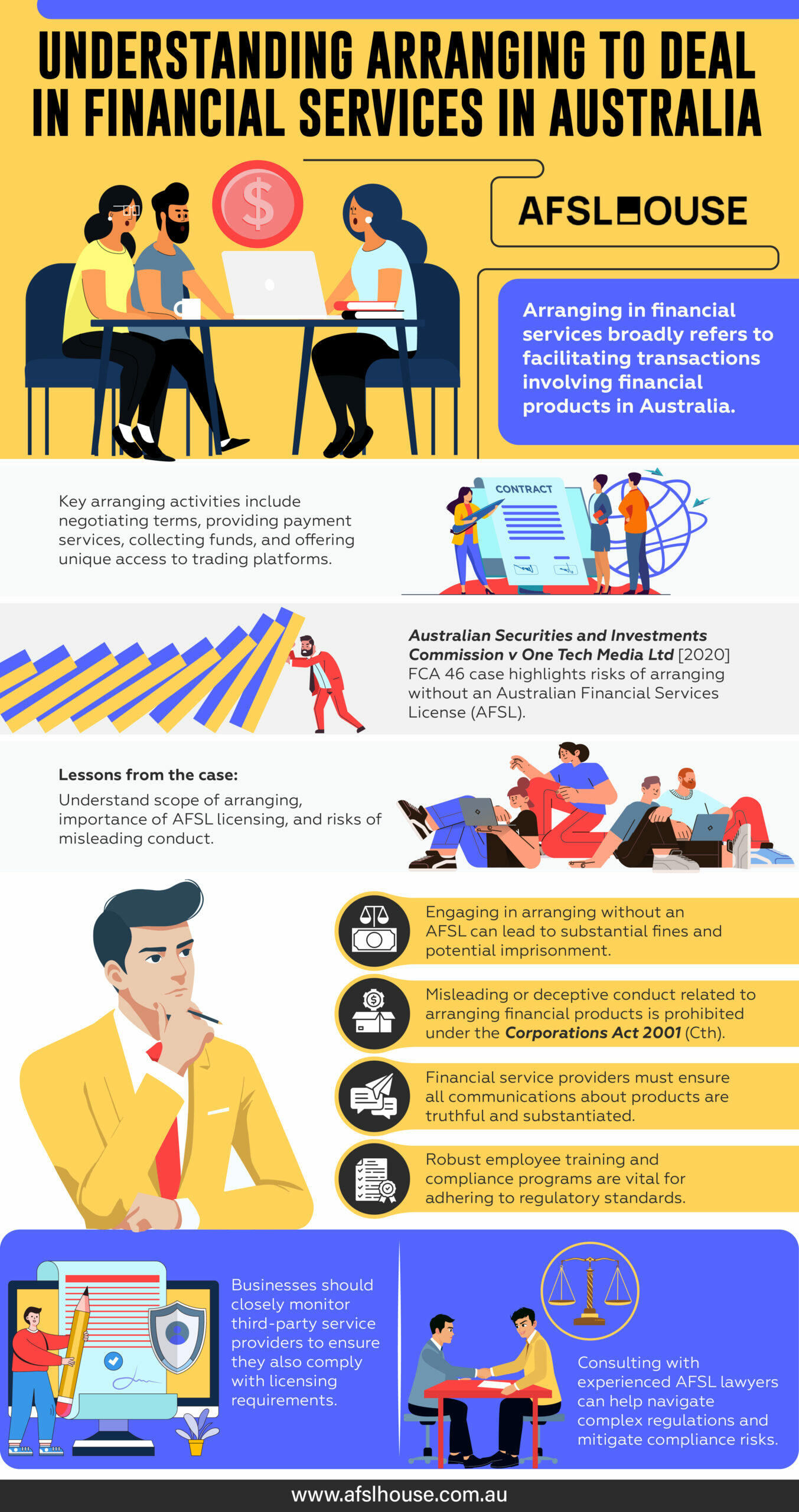
How Does ASIC Decide If Your Conduct Is Arranging?
ASIC treats arranging as a question of degree, and says your conduct may be arranging if three things apply (RG 36.43):
- your involvement is so important that without it the transaction would probably not take place, such as where you are the main or only person the consumer deals with;
- your involvement significantly adds value for the person you act for; and
- you receive benefits depending on the decisions that person makes.
The list isn’t exhaustive, and no single factor is conclusive. ASIC also looks for the consumer communicating with you as a key person about the transaction, and for you negotiating the product’s terms between the issuer and the consumer. Collecting money and passing it to the issuer, and being paid by the issuer when someone buys, may also point to arranging, though ordinarily one of these alone would not (RG 36.45, Tables 2 and 3).
Benefits paid on sales can also raise the conflicted remuneration rules if you give financial product advice to retail clients (RG 36, Table 3 note).
Get Your Free Initial Consultation
Consult with one of our experienced ACL & AFSL Lawyers today.
What Doesn’t Count as Arranging?
ASIC lists conduct that isn’t arranging, though it warns that some of it may still be another financial service (RG 36.47 to 36.54):
- Dealing as principal: dealing in your own name isn’t arranging, and in most cases doesn’t need a licence (s 766C(3) to (5); RG 36.48).
- Dealing as agent: acting in another person’s name with power to bind them is dealing as agent rather than arranging, and may still need an authorisation to deal on behalf of another (RG 36.49).
- Financial product advice: conduct that amounts to advice isn’t arranging (s 766C(2); RG 36.50), but it is a separate financial service.
- Purely factual information: information that is objectively ascertainable is unlikely to be arranging (RG 36.51).
- Clerks and cashiers: routine clerical, processing or receipting work is exempt (s 766A(3)), but the combined clerical work of a business may amount to a financial services business (RG 36.52, 36.53).
- Licensed markets: a service provided as, or incidentally to, the operation of a licensed market or clearing and settlement facility is exempt (s 911A(2)(d); RG 36.54).
- Crowd-funding services: providing a crowd-funding service isn’t dealing (s 766C(2A)).
Is Sharing a Link, Form or Brochure Arranging?
It depends on how close you are to completing the transaction: passing on material or names usually isn’t arranging, while an exclusive, paid route to the product usually is. ASIC’s examples (RG 36.55, Table 4; INFO 269):
| What you do | ASIC’s view |
|---|---|
| Point out where a consumer fills in their details on an application form, or type them in | Unlikely to be arranging, without further actions |
| Forward or display another person’s brochures, even if you’re paid on sales | Not likely to be arranging, without further actions |
| Provide an ordinary internet link the consumer could use on their own computer | Not likely to be arranging |
| Provide a special direct link to the issuer that can only be accessed through your business | Likely to be arranging |
| Promote a unique link to a licensee’s trading platform, paid per click-through, with a benefit for followers who use it | Likely to be dealing by arranging |
| Give the names and details of licensees, with no further involvement | Unlikely to be dealing by arranging |
Read more in our guide to promoting financial products online as a finfluencer.
Speak with an ACL & AFSL Lawyer Today
Request a Consultation to Get Started.
What Did the Court Decide in ASIC v One Tech Media?
The Federal Court found that a company providing paying agency services for a binary options issuer was arranging for the issuer to deal in financial products, and contravened s 911A by doing so without an AFSL (ASIC v One Tech Media Ltd [2020] FCA 46). The Court held that the paying agency services were a key part of the trading in binary options through the websites.
The two individuals who effectively controlled the operation were also found to have arranged for the issue of the binary options. They contravened s 1012B(3) by offering to arrange for the issue of financial products to website customers without giving them a Product Disclosure Statement. The case shows that handling customers’ money for an issuer can make a payment business part of the dealing.
What Licence Do You Need to Arrange?
A business that arranges needs an AFSL authorising it to deal in the relevant financial products, or must provide the service as a representative of a licensee that holds that authorisation (s 911A(1), (2)(a)). ASIC says the authorisation to deal on behalf of another also covers arranging (RG 36, Example 1).
ASIC warns that the Corporations Act imposes significant penalties for carrying on a financial services business without a licence or an exemption, including up to five years’ imprisonment for an individual and financial penalties into the millions of dollars for a corporation (INFO 269). Read more about the consequences of operating without an AFSL.
Get Your Free Initial Consultation
Consult with one of our experienced ACL & AFSL Lawyers today.
How Do You Check Whether Your Business Is Arranging?
Work through each product and each step you take in the transaction:
- Check the product is a financial product, and which dealing step you’re involved in.
- Check the exclusions first: own-name dealing, advice, factual information, clerical work and licensed markets.
- Test your role against RG 36.43: would the deal probably happen without you, do you add value, and are you paid on outcomes?
- Compare your model with ASIC’s examples, especially exclusive links and handling client money.
- Get the authorisation to deal, or become a licensee’s authorised representative, before you start.
AFSL House’s lawyers can assess whether your business model involves arranging and prepare an AFSL application with the right dealing authorisations.
Frequently Asked Questions
These are the questions businesses ask most about arranging and s 766C.
Does the Corporations Act define “arranging”?
No. Section 766C(2) says arranging for a person to engage in dealing conduct is also dealing, but the Act doesn’t define arranging. ASIC describes it as bringing into effect the issue, variation, disposal or acquisition of, or application for, a financial product, and says the courts haven’t fully settled its scope (RG 36.42).
Is arranging the same as dealing?
Arranging is one way of dealing. Under s 766C(1), dealing means applying for or acquiring, issuing, underwriting (for securities and scheme interests), varying or disposing of a financial product, as principal or agent. Section 766C(2) adds arranging for another person to do any of those things. Read our guide to dealing in a financial product.
Is giving financial product advice also arranging?
No. Section 766C(2) excludes actions that amount to providing financial product advice, which is conduct intended to influence a decision about a financial product or that could reasonably be regarded as intended to do so (RG 36.50). Advice is a separate financial service, so it needs its own authorisation. Read more about financial product advice.
Does being paid commission make it arranging?
Not on its own. ASIC treats receiving benefits based on sales as an indicator that may point to arranging, because it shows a motive to complete the transaction, but says one indicator alone ordinarily wouldn’t amount to arranging (RG 36, Table 3). Commission combined with an exclusive link or a key role in the transaction is more likely to be arranging.
Do I need a licence if I only collect and pass on client money?
Possibly. ASIC lists receiving money and passing it to the issuer as an indicator that may point to arranging (RG 36, Table 3), and in ASIC v One Tech Media Ltd [2020] FCA 46 a paying agency business was found to be arranging for the issue of binary options. Get advice on your payment model before you start.
Is buying and selling for my own account arranging?
No. ASIC says dealing in financial products in your own name isn’t arranging, and in most cases doesn’t need a licence (RG 36.48). An issuer of financial products dealing in its own products is the main exception under s 766C(3), so issuers still need to check their licensing position.
Are my staff arranging when they process client paperwork?
Individual staff doing merely routine clerical, processing or receipting work are covered by the clerks and cashiers exemption in s 766A(3). ASIC warns, though, that the combined clerical activities of a business may amount to a financial services business of dealing, arranging or advising (RG 36.52, 36.53), so the business itself may still need a licence.
Can an authorised representative arrange for clients?
Yes, if the licensee authorises it. A person who provides a financial service as a representative of a licensee that holds the relevant authorisation is exempt from holding their own AFSL (s 911A(2)(a)). The licensee’s authorisation must cover dealing in the products involved, and the representative must act within it.
Is a crowd-funding platform arranging?
Providing a crowd-funding service is not dealing in a financial product under s 766C(2A), so it isn’t arranging for that purpose. Crowd-sourced funding is regulated under its own rules, so check whether anything else you do, such as advising investors, is a separate financial service. Read our guide to AFSLs for crowd-sourced funding services.
Disclaimer: All information provided in this article is strictly general in nature and is not intended to be, nor should it be relied upon as, legal advice.