
What Is a Retail Client?
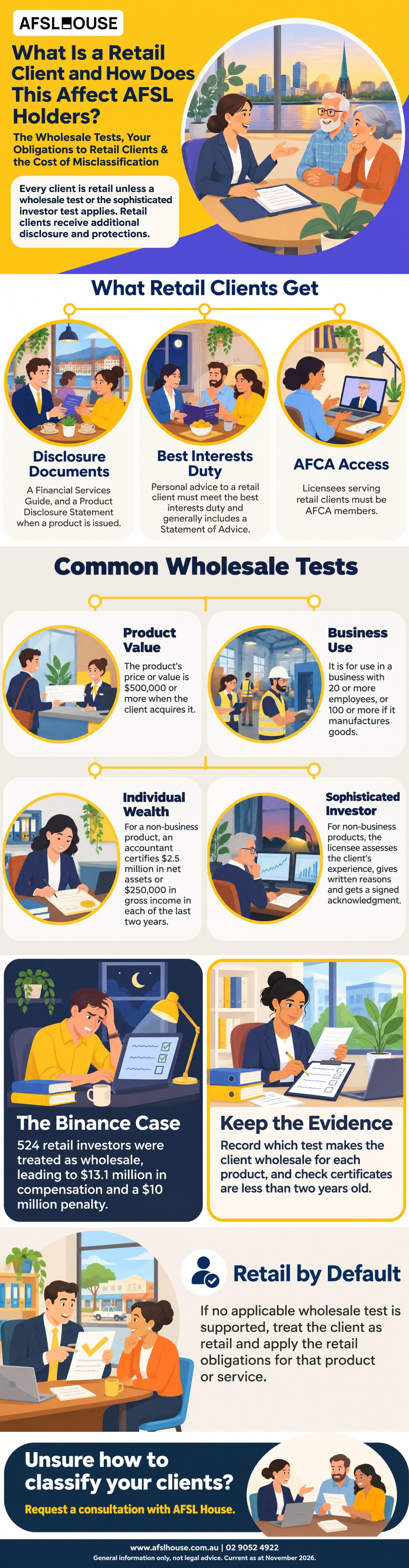
Anyone you provide a financial product or financial service to, unless the law treats them as a wholesale client (s 761G(1), (4) of the Corporations Act 2001 (Cth) (‘Corporations Act’)). Retail is the default, so an Australian Financial Services Licence (‘AFSL’) holder needs a basis for treating any client as wholesale.
Some products follow special rules. Superannuation products and retirement savings accounts are provided to clients as retail clients (s 761G(6)(a)). Motor vehicle, home building, home contents, sickness and accident, consumer credit, travel and some other general insurance products are retail when provided to an individual or a small business (s 761G(5)).
For other products, a client is wholesale only if one of these tests applies:
| Test | When it applies |
|---|---|
| Product value | The price or value of the product is $500,000 or more (s 761G(7)(a); reg 7.1.18) |
| Business use | The product or service is for a business that isn’t a small business, meaning one with fewer than 20 employees, or 100 if it manufactures goods (s 761G(7)(b), (12)) |
| Individual wealth | For a product not used in connection with a business, a qualified accountant certifies net assets of at least $2.5 million, or gross income of at least $250,000 in each of the last two financial years (ASIC’s accountant certificate page) |
| Professional investor | The client is a licensee, an APRA-regulated body, a listed entity, a person who controls at least $10 million or another listed type of investor (s 9) |
| Sophisticated investor | For a non-business product, the licensee is satisfied on reasonable grounds that the client has enough experience, gives written reasons and gets a signed acknowledgment (s 761GA) |
What Do AFSL Holders Owe Retail Clients?
More disclosure, access to dispute resolution and, for personal advice, the best interests duty. The main obligations are:
- a Financial Services Guide (s 941A), and a Product Disclosure Statement when a product is issued to them (s 1012B);
- a general advice warning with general advice (s 949A), and generally a Statement of Advice with personal advice (s 946A);
- for personal advice, the best interests duty, appropriate advice, a warning if the advice is based on incomplete or inaccurate information, and priority to the client’s interests (ss 961B, 961G, 961H and 961J);
- a dispute resolution system, including membership of the Australian Financial Complaints Authority (‘AFCA’), and compensation arrangements (s 912A(1)(g), (2); s 912B); and
- a target market determination for products that need a Product Disclosure Statement (s 994B).
Licensees must take reasonable steps to make sure their representatives comply with the best interests obligations, and that duty is a civil penalty provision (s 961L). Your licence must also authorise services to retail clients (RG 1.40). Our guide to retail and wholesale clients compares the two.
Get Your Free Initial Consultation
Consult with one of our experienced ACL & AFSL Lawyers today.
How Do You Classify Clients Correctly?
Start from retail and record the test that makes each client wholesale:
- Check whether the product is superannuation or a listed general insurance product, which are retail for most clients.
- For the product value test, check the price or value against $500,000 when the client acquires the product.
- For the individual wealth test, confirm the product isn’t used in connection with a business, then check that the accountant’s certificate is from a qualified accountant, covers the right test and is less than two years old.
- For the sophisticated investor test, confirm it’s a non-business product, assess the client’s experience, give written reasons and get the signed acknowledgment before you provide the product.
- Keep the evidence, and recheck clients before certificates expire.
Example: A client gives you an accountant’s certificate dated 26 months ago, showing net assets of $3 million.
What it means: the certificate is more than two years old, so you can’t rely on it. Treat the client as retail until you have a current certificate or another test applies.
Speak with an ACL & AFSL Lawyer Today
Request a Consultation to Get Started.
What Happens If You Misclassify a Retail Client?
The client keeps the protections of a retail client, so you may have breached your disclosure and conduct obligations. Binance Australia Derivatives shows the cost (ASIC media release 26-055MR):
- it treated 524 retail investors, more than 85% of its Australian clients, as wholesale between July 2022 and April 2023;
- clients seeking sophisticated investor status could retake a multiple-choice quiz as many times as they liked until they passed, and 460 clients were wrongly classified under that test;
- the misclassified clients lost $8.66 million in trading and paid $3.89 million in fees, and Binance paid about $13.1 million in compensation in 2023; and
- in March 2026, the Federal Court ordered a $10 million penalty after Binance admitted failing to give Product Disclosure Statements, make a target market determination and maintain a compliant internal dispute resolution system, among other contraventions.
ASIC cancelled Binance’s AFSL at its request in April 2023 (26-055MR). Our guide to AFCA membership explains how retail complaints are handled.
AFSL House’s compliance lawyers can review your client classification process and records.
Frequently Asked Questions
These are the questions licensees ask most about retail clients.
What is a retail client?
Any client you provide a financial product or service to, unless a wholesale test or the sophisticated investor test applies (s 761G(1); s 761GA). Retail clients get more disclosure, access to AFCA and, for personal advice, the best interests duty.
Are superannuation products always retail?
Generally, yes. Superannuation products and retirement savings accounts are generally provided as retail products, so the usual wholesale tests don’t apply to them (s 761G(6)(a)). There’s a narrow exception for interests in pooled superannuation trusts provided to certain trustees (s 761G(6)(aa)).
Which general insurance products are retail?
Motor vehicle, home building, home contents, sickness and accident, consumer credit, travel and some other general insurance products, when provided to an individual or for use in a small business (s 761G(5)). Other general insurance products are generally wholesale.
How long is an accountant’s certificate valid?
Up to two years after it’s issued (ASIC’s accountant certificate page). It must be from a qualified accountant and state that the client meets the net assets or gross income threshold. Recheck the date each time you rely on it.
Can a client choose to be treated as wholesale?
Not just by asking. A wholesale test must apply, or the licensee must be satisfied on reasonable grounds that the client is a sophisticated investor, give written reasons and get the client’s signed acknowledgment (s 761GA). A client’s signature alone isn’t enough.
What is a small business for the business test?
A business employing fewer than 20 people, or fewer than 100 people if it manufactures goods (s 761G(12)). If the product is for use in a larger business, the client is wholesale for that product (s 761G(7)(b)).
Does the best interests duty apply to wholesale clients?
No. The best interests obligations apply to personal advice given to a retail client (s 961(1)). They don’t apply to general advice or to wholesale clients, although other licensee obligations still do.
Can retail clients complain to AFCA?
Yes. Licensees that provide financial services to retail clients must have a dispute resolution system that includes AFCA membership (s 912A(1)(g), (2)). AFCA gives retail clients an independent way to resolve complaints.
What happens if a licensee misclassifies a client?
The client keeps the protections of a retail client, so the licensee may have failed to give required documents or meet conduct obligations. That can lead to compensation, AFCA complaints and ASIC action, as Binance’s $10 million penalty shows (26-055MR).
Disclaimer: All information provided in this article is strictly general in nature and is not intended to be, nor should it be relied upon as, legal advice.