
Does a Foreign Business Need an AFSL to Serve Clients in Australia?
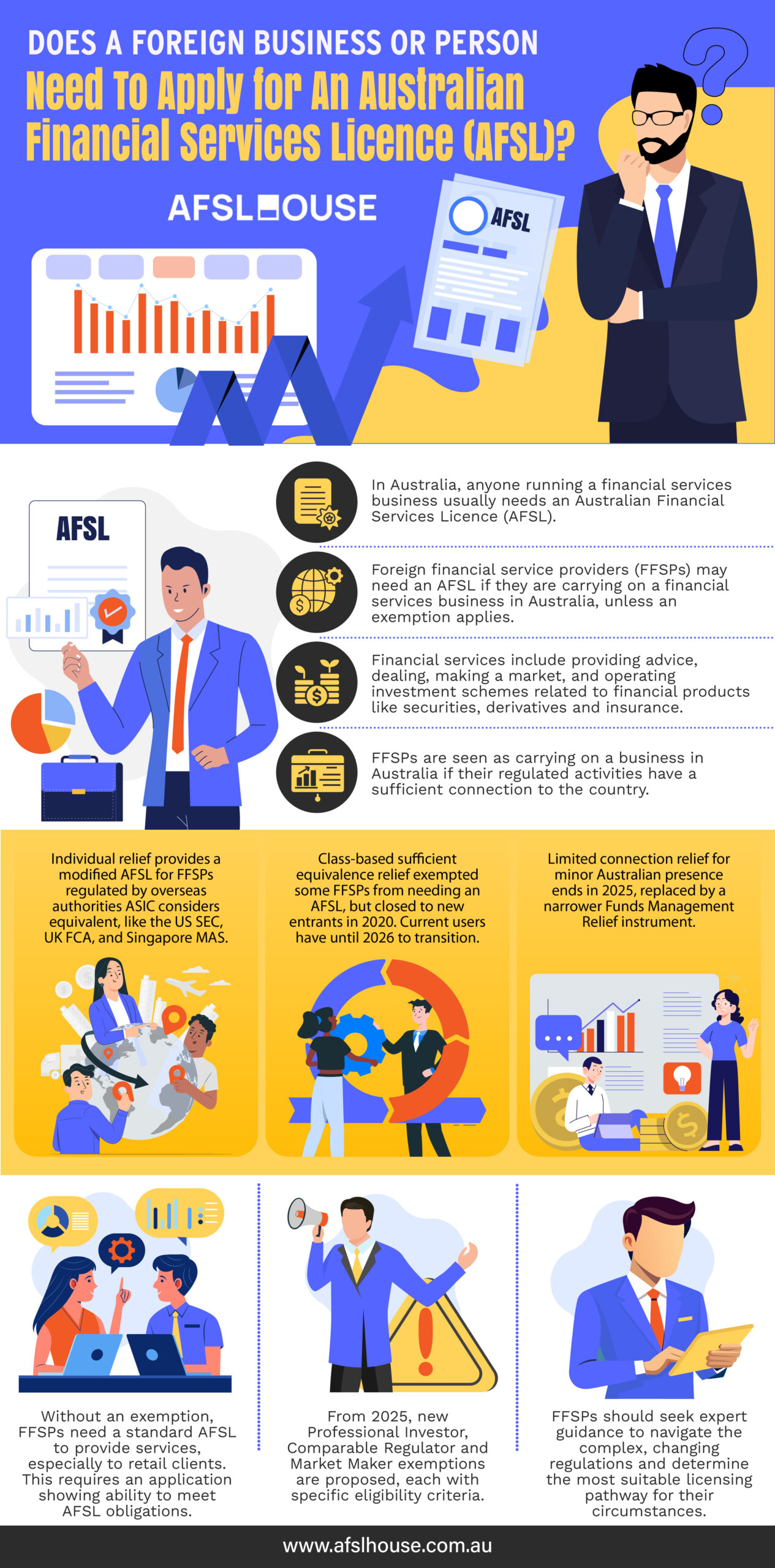
Yes, if it carries on a financial services business in Australia, unless an exemption or ASIC relief applies. Under s 911A(1) of the Corporations Act 2001 (Cth) (‘Corporations Act’), anyone who carries on a financial services business in this jurisdiction must hold an Australian Financial Services Licence (‘AFSL’) covering the services. That applies to a company or person based overseas just as it does to an Australian one.
The hard questions come in order. First, does your activity count as carrying on business here, given that marketing to Australians can be enough? Then, which route covers you, knowing that the Australian Securities and Investments Commission (‘ASIC’) relief many foreign providers use is due to end and new statutory exemptions start on 8 April 2027.
| Route | Who it suits | Status |
|---|---|---|
| Own AFSL | Any provider, and generally the route for retail clients | Available now |
| ASIC relief | Foreign providers serving wholesale clients only (INFO 157) | Individual relief available now; transitional relief due to end on 31 March 2027 |
| New exemptions | Providers to professional investors, comparably regulated providers to wholesale clients, and some market makers | From 8 April 2027 |
When Is a Foreign Business Carrying On Business in Australia?
When it has a place of business here or its activities here have system, repetition and continuity, though even one transaction can be enough. For a company, the Act settles the first part: a body corporate with a place of business in Australia carries on business here, and so does one that uses a share transfer or registration office here, or deals with property here as an agent, legal personal representative or trustee (s 21(1) and (2); RG 121.43).
Some activities don’t make a company a business here on their own, such as keeping a bank account, holding directors’ meetings, or an isolated transaction completed within 31 days that isn’t one of a number of similar transactions (s 21(3); RG 121.44). But for a financial services business, soliciting orders that only become binding when accepted overseas doesn’t take you outside the rule (s 21(4)).
Beyond those rules, ASIC says the courts look at the facts, and especially at whether your Australian activities have system, repetition and continuity (RG 121.47). The trap is that a single deal can still count.
Watch out · RG 121.48
ASIC says that if the financial services you provide in Australia are more than very minor, and in particular have elements of system, repetition and continuity, you are likely to need an AFSL unless an exemption applies. It adds that a one-off transaction may also amount to carrying on a business, such as where it is intended to be the first in a series, citing Gebo Investments (Labuan) Ltd v Signatory Investments Pty Ltd [2005] NSWSC 544.
What it means: don’t treat your first Australian client as a free trial. If you plan to build an Australian book, sort out your licence or exemption before the first deal.
Your people on the ground matter too. ASIC points out that the acts of an agent acting within their actual or apparent authority are generally attributed to the principal, so a company can carry on business in Australia through an Australian-based agent (RG 121.49; s 769B).
Can Marketing to Australians Alone Trigger the Licence?
Yes. Conduct intended to induce people in Australia to use your services, or likely to have that effect, is taken to be carrying on business here. The deeming rule covers conduct “intended to induce people in this jurisdiction to use the financial services the person provides” or that “is likely to have that effect”, whether or not it is also aimed at other countries (s 911D(1)).
ASIC says inducing includes attempts to persuade, influence or encourage a particular person to become a client (RG 121.51). Its own examples show where the line falls.
ASIC example · RG 121 Table 1
A Singapore insurance company advertising its products in an Australian newspaper is likely to need an AFSL, even before it provides any financial services here. By contrast, a Hong Kong broker whose website advertisement can be seen from Australia, but isn’t targeted at people in Australia, carries a jurisdictional disclaimer and has little impact on investors here, may not need one if there is no inducing.
What it means: targeting decides it. Australian-facing ads, local events, direct approaches to Australian investors and Australian contact details all point towards inducing, so review your marketing before you change your licensing plan.
If you are already caught, the penalties for operating without an AFSL apply to foreign providers too: failing to comply with s 911A(1) is an offence, and s 911A(5B) is a civil penalty provision.
Get Your Free Initial Consultation
Consult with one of our experienced ACL & AFSL Lawyers today.
What Options Does a Foreign Provider Have Today?
An AFSL of your own, ASIC relief if you serve only wholesale clients, or an exemption such as acting for an Australian licensee. Which one fits depends mostly on your clients:
- Your own AFSL: available to any provider, and generally needed for retail clients, because the relief and the foreign provider exemptions cover only wholesale clients or professional investors. You apply through the ASIC Regulatory Portal like any applicant (INFO 294).
- Individual relief: ASIC no longer grants class relief, but a new foreign provider serving wholesale clients can apply for individual licensing relief, whether or not its home regulator is one ASIC has assessed as sufficiently equivalent (INFO 157).
- Transitional relief: foreign providers that relied on ASIC’s class relief before 31 March 2020 can generally keep relying on it, and limited connection relief covers some wholesale business, but both are due to end on 31 March 2027 (INFO 157; ASIC news item, 5 December 2025).
- A foreign AFS licence: providers already granted one can keep operating under it (ASIC news item, 5 December 2025), as covered in what a foreign AFS licence is.
- Acting with an Australian licensee: you don’t need your own AFSL for a service you provide as the representative of a licensee whose licence covers it (s 911A(2)(a)), and ASIC lists other exemptions for business carried on in connection with an AFS licensee (RG 121.56).
Two steps apply whichever route you take. ASIC says a provider seeking relief must first work out whether it is carrying on business in Australia under s 21, and if it is, register as a foreign company under Division 2 of Part 5B.2 (INFO 157). And if you serve retail clients, check how retail and wholesale clients are defined before you rely on any relief, because a misclassified client takes you outside it.
The 31 March 2027 end date may move. ASIC has proposed extending the transitional relief by six months, to 1 October 2027, in a consultation closing on 4 December 2026 (ASIC news item, 6 November 2026). It also proposes conditional class relief for providers with a related AFS licensee that serve institutional investors mainly from offshore. Both are only proposals, so plan around 31 March 2027 until ASIC confirms the extension.
Speak with an ACL & AFSL Lawyer Today
Request a Consultation to Get Started.
What Changes on 8 April 2027?
Three statutory exemptions for foreign providers start, each requiring a notice to ASIC. Schedule 2 of the Treasury Laws Amendment (Genetic Testing Protections in Life Insurance and Other Measures) Act 2026 commences on “the day after the end of the period of 12 months beginning on the day this Act receives the Royal Assent” (s 2, table item 3). Royal Assent was on 8 April 2026, so that day is 8 April 2027, and Schedule 2 inserts these exemptions into s 911A(2):
- Professional investor exemption (s 911A(2)(eo)): the service is provided only to professional investors, from a place outside Australia except during limited marketing visits, by a provider whose head office and principal place of business are outside Australia and who reasonably believes the service wouldn’t contravene the law where it operates;
- Comparable regulator exemption (s 911A(2)(ep)): the service is provided only to wholesale clients by a foreign company or partnership that holds the authorisations it needs to provide the same or substantially the same service in a jurisdiction whose regulator the Minister has determined is comparable; and
- Market maker exemption (s 911A(2)(eq)): the service is making a market for derivatives able to be traded on a licensed market prescribed by the regulations, provided from outside Australia by a provider with its head office and principal place of business outside Australia.
For each one, the provider must notify ASIC that it intends to rely on the exemption, and ASIC says it will publish more on the notification process before the regime starts (ASIC news item, 6 November 2026).
Services provided in Australia during a representative’s marketing visits can still fall within the professional investor exemption, but not on a day when that representative’s marketing visits in the financial year already total 28 days or more (s 911E). Each exemption also comes with conditions, and contravening one can be a civil penalty contravention (s 911G(4)).
Watch out · Schedule 2, ss 911R to 911U
ASIC may cancel an exemption for a person who contravenes a condition for it, or whom ASIC reasonably believes has contravened the condition about providing financial services efficiently, honestly and fairly, or is not a fit and proper person (ss 911R and 911S). ASIC must first give a show cause notice (s 911T), and where a condition is contravened it can impose additional conditions as an alternative to cancelling (s 911U).
What it means: an exemption isn’t a one-time filing. Build its conditions into your compliance monitoring the same way you would a licence condition.
The detail of each exemption, and how it compares with the relief it replaces, is in the AFSL exemptions for foreign companies and the Treasury Laws Amendment reforms for foreign providers.
Get Your Free Initial Consultation
Consult with one of our experienced ACL & AFSL Lawyers today.
How Should a Foreign Provider Choose Its Route?
Work out whether you are caught, who your Australian clients are, and which route you can rely on both now and after 8 April 2027. In order:
- Test your activity: a place of business, system and repetition, an Australian agent, or marketing aimed at Australians can each bring you within the licensing requirement.
- Classify your clients: retail clients generally mean an AFSL; wholesale clients or professional investors may open relief or an exemption.
- Check today’s cover: individual relief, transitional relief and its end date, or acting with an Australian licensee.
- Plan for 8 April 2027: confirm whether you’ll meet an exemption’s conditions and when you’ll notify ASIC, or start an AFSL application early enough.
- Register if needed: if you are carrying on business here, register as a foreign company.
AFSL House can prepare your AFSL application and manage ASIC’s requests through to grant, or help you confirm whether an exemption fits your Australian business.
Frequently Asked Questions
Quick answers on checking licences, fees, registration and the 2027 changes.
How Can You Check a Firm’s AFSL Number?
Search the number on ASIC’s professional registers. Then check that the licence is current and that the licensee named there is the firm you are dealing with, because an overseas firm may quote another entity’s number. If the firm says it relies on an exemption instead, ask which one and when it notified ASIC.
Does a Foreign Company Need to Register in Australia?
If it carries on business in Australia, yes. ASIC says a foreign provider that is carrying on business here under s 21 must register as a foreign company under Division 2 of Part 5B.2. If it isn’t carrying on business here, ASIC still requires a provider relying on its relief to appoint a local agent (INFO 157).
What Does ASIC Charge for Individual Relief?
$3,487 from 1 July 2026. INFO 157 points to item 80 of the fee schedule and says payment is required with your application, and ASIC’s fees page lists item 80 at that amount. There’s no fee for the ongoing notifications a provider must make after relief is granted (INFO 157).
Can a Foreign Provider Act Through an Australian Licensee?
Yes. You don’t need your own AFSL for a service you provide as the representative of a licensee whose licence covers it (s 911A(2)(a)). The licensee then carries responsibility for how you provide the service, so compare the AFSL and authorised representative routes before you commit.
Who Decides Which Overseas Regulators Are Comparable?
The Minister, by legislative instrument (s 911W(1), from 8 April 2027). The Minister must consider whether the regime produces broadly comparable outcomes, is clear, transparent, certain and adequately enforced, and is broadly consistent with IOSCO’s principles, and whether the regulator has an effective cooperation arrangement with ASIC (s 911W(2)).
Can a Comparably Regulated Provider Get an AFSL More Easily?
Possibly, for a wholesale-only licence. From 8 April 2027, the fit and proper person test doesn’t apply to a foreign company or partnership whose licence would be restricted to wholesale clients and that holds the authorisations it needs from a comparable regulator (s 913B(2A)). ASIC still assesses the rest of the AFSL application.
Do the New Exemptions Cover Retail Clients?
No. The professional investor exemption covers only professional investors, and the comparable regulator exemption covers only wholesale clients (s 911A(2)(eo) and (ep)). A foreign provider that wants Australian retail clients generally needs an AFSL, or must provide the service as a licensee’s representative.
What Happens After the Transitional Relief Ends?
Providers relying on it will need to move to the new regime or apply for an AFSL, as ASIC has said (ASIC news item, 6 November 2026). The relief is due to end on 31 March 2027, or on 1 October 2027 if ASIC confirms its proposed extension. So check now whether one of the new exemptions fits your business.
Is Limited Connection Relief Still Available?
Only until its end date. It covers foreign providers that are carrying on business in Australia only because of inducing conduct under s 911D, for wholesale clients, and is due to end on 31 March 2027 unless extended (INFO 157; ASIC news item, 5 December 2025). After that, the professional investor exemption may cover some of the same ground.
Disclaimer: All information provided in this article is strictly general in nature and is not intended to be, nor should it be relied upon as, legal advice.