
Introduction
Applying for and maintaining an Australian Financial Services Licence (‘AFSL’) entails significant costs, both upfront and ongoing. Accurate cost assessment is crucial for financial service companies and start-ups considering self-licensing. This assessment helps businesses make informed decisions, budget effectively, and avoid unexpected financial burdens.
This article provides a comprehensive overview of indicative AFSL costs, covering application, set-up, and ongoing compliance. We will also delve into real-world cost examples from a law firm specialising in financial services licensing, offering practical insights for businesses navigating the AFSL landscape.
Get Your Free Initial Consultation
Consult with one of our experienced ACL & AFSL Lawyers today.
Set-Up Costs for Your AFSL Licence Application
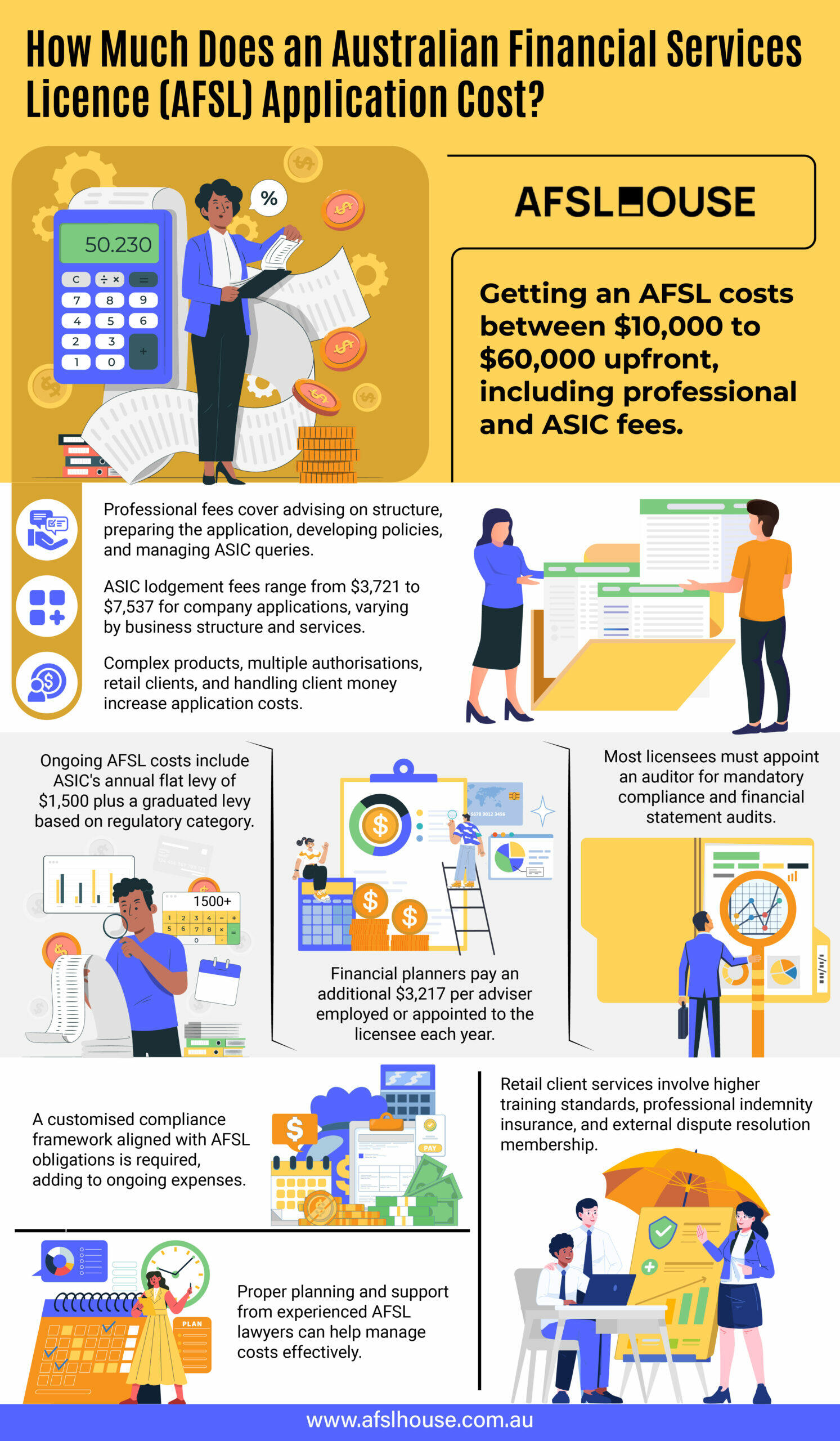
The initial costs to apply for an AFSL typically range between $10,000 to $60,000, depending on the complexity of your application. The total cost includes both professional fees and Australian Securities and Investments Commission (‘ASIC’) lodgement fees.
Professional Fees for Preparing and Submitting an AFSL Application
Professional fees for AFSL application preparation and submission vary based on the authorisations being sought and the complexity of your business arrangements, so consulting experienced AFSL lawyers can help clarify your expected costs. A standard AFSL application package typically includes:
- Advising on shareholding structure for the AFSL company
- Guidance on selecting appropriate responsible managers
- Preparation of all required supporting documents, including the new streamlined ‘People Proofs’ for all responsible persons
- Development of customised policies and procedures
- Creation of privacy compliance and anti-money laundering and counter-terrorism financing compliance programs
- Managing ASIC queries and requisitions
- Guidance and completion of the online AFSL application ‘transaction’ within the ASIC Regulatory Portal, as well as support for ACL applications if your business requires both licences.
ASIC Lodgement Fees for AFSL Applications
ASIC’s application fees vary significantly based on your business structure and the type of financial services you plan to provide:
- For a company serving retail clients with lower-complexity products: $3,721 when lodged online through the ASIC Regulatory Portal
- For a company serving retail clients with higher-complexity products: $7,537 when lodged online (lower fees of $2,233 and $5,025 apply where services are provided only to wholesale clients)
- Individual applications may have different fee structures compared to corporate applications
The fees are typically lower for simpler licence applications and increase with the complexity of the authorisations being requested. Some businesses instead consider acquiring an entity that already holds an AFSL through the AFSL marketplace, which brings its own due diligence and change-of-control costs. Factors that can drive up costs include:
- Complex financial products (e.g., derivatives or foreign exchange)
- Multiple authorisations requiring multiple Responsible Managers
- Membership in a large corporate group
- Providing services to retail clients
- Handling client money or assets
Speak with an ACL & AFSL Lawyer Today
Request a Consultation to Get Started.
Ongoing AFSL Compliance Costs and Obligations for Licensees
ASIC Industry Funding Levy for AFS Licensees
ASIC recovers its regulatory costs through an annual industry funding levy, made up of a minimum levy and, for many subsectors, a graduated component based on the licensee’s activity, such as the number of advisers it has. The amounts are recalculated each year from ASIC’s actual costs and published in its annual levy estimates. Licensees that give personal advice to retail clients on relevant financial products also pay the Compensation Scheme of Last Resort levy, which has become a significant ongoing cost.
Audit and Compliance Framework Costs for Maintaining an AFSL
Most licensees must appoint an auditor to audit their annual financial statements and report on their compliance, although a limited AFS licensee, such as an accountant, that does not deal with client money lodges a compliance certificate with its annual financial statements. Additional costs include establishing and maintaining a robust compliance framework.
The compliance framework must be customised to meet all AFSL obligations, including policies and procedures that align with AFSL compliance regulation requirements.
Additional Costs for Retail Client Services under an AFSL
Licensees providing services to retail clients face several additional mandatory expenses:
- Higher training standards and increased supervision requirements for representatives, as these are key to demonstrating organisational competence
- Professional indemnity insurance coverage to protect against potential claims and meet regulatory requirements
- Membership fees for an external dispute resolution scheme to handle customer complaints and meet regulatory obligations
These ongoing compliance costs vary depending on the type of licence held and services provided. The total expense structure is designed to ensure licensees maintain appropriate standards while protecting consumer interests.
Conclusion
Understanding the true costs of obtaining and maintaining an AFSL is crucial for financial services businesses considering self-licensing. Despite common misconceptions about astronomical expenses, the reality is more manageable when approached with proper planning and the right support structure.
To explore cost-effective strategies for your AFSL application and ongoing AFSL compliance, consider reaching out to our team at AFSL House. We provide tailored advice and practical insights to help you optimise your licensing budget and ensure long-term financial sustainability.
Frequently Asked Questions
Disclaimer: All information provided in this article is strictly general in nature and is not intended to be, nor should it be relied upon as, legal advice.